Project
Scaling Language Access With AI
Organization: U.S. Digital Response + State of Arizona Department of Economic Security
Date: 2025
Formats: Benefits lexicon, plain language definitions, Spanish translation support, prompt evaluation, user research support, AI-assisted translation workflow, quality rubrics, staff guidance
Relevant skills: Public benefits, SNAP, language access, Spanish bilingual content strategy, user research, plain language, AI-assisted workflows, stakeholder engagement
Date: 2025
Formats: Benefits lexicon, plain language definitions, Spanish translation support, prompt evaluation, user research support, AI-assisted translation workflow, quality rubrics, staff guidance
Relevant skills: Public benefits, SNAP, language access, Spanish bilingual content strategy, user research, plain language, AI-assisted workflows, stakeholder engagement
Executive Summary
Arizona’s Department of Economic Security partnered with U.S. Digital Response to prototype a human-led, AI-assisted translation workflow for public benefits content, beginning with SNAP/Nutrition Assistance. I served on the content team as a Spanish bilingual content strategist, helping refine plain language definitions, support Spanish translation review, assist with user research, troubleshoot AI outputs, and create usage guidance. The project helped DES explore how AI could expand language access while maintaining human oversight, quality, and trust.
Core Problem
DES serves a large, linguistically diverse population and needed a more scalable way to provide consistent translations across 60+ programs and 15 threshold languages. Existing workflows were costly, slow, decentralized, and difficult to maintain when policies or programs changed. The USDR case study notes that DES has 8,000+ employees and faced the challenge of providing consistent, high-quality translations across many programs and languages.
Strategic Approach
The engagement focused on SNAP as the pilot and combined product management, engineering, content strategy, user research, and design. The core strategy was not to create a “black box” AI tool, but to build internal capacity through a SNAP-specific lexicon, configurable prompt library, quality evaluation framework, staff workshops, and human-led workflows.
Solution & Execution
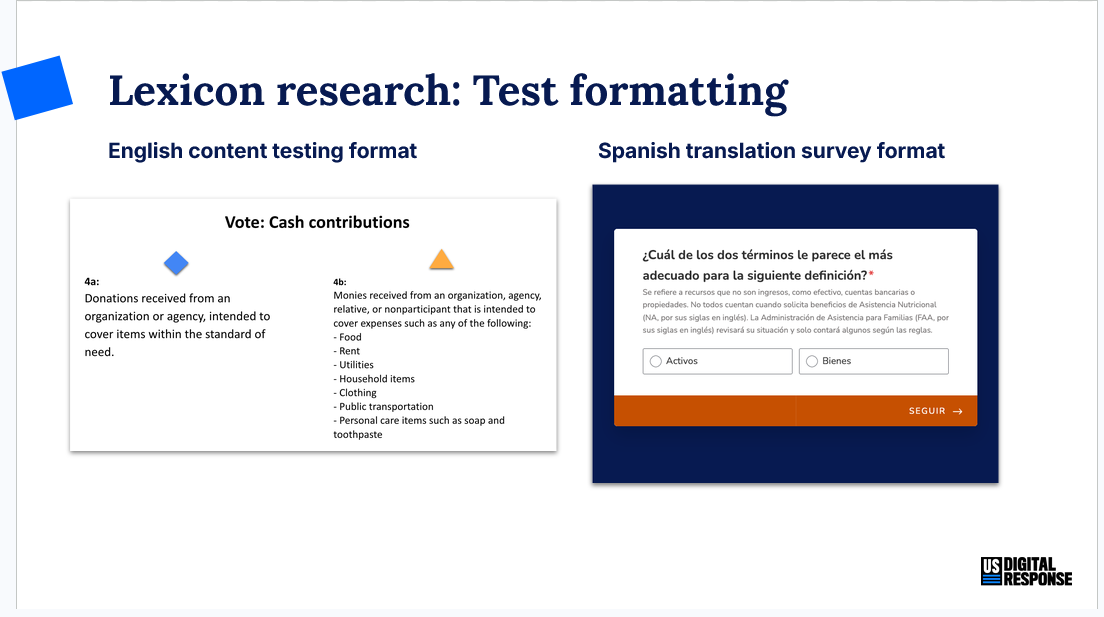
As part of the content team, I supported the plain language and Spanish content work. My contributions included reviewing and refining plain language definitions, supporting Spanish translations and UX research, creating usage guidelines and examples, reviewing AI-generated outputs for clarity and quality, and helping connect content insights to the broader product/research effort. The Arizona scoping document specifically identifies my content strategist role as reviewing and refining plain language definitions, supporting Spanish translations and UX research, and creating usage guidelines and examples.
Deliverables
- SNAP-specific benefits lexicon support
- Spanish-language user testing
- Plain language definitions
- Usage guidelines and examples
- Spanish translation review
- Support for user research with English- and Spanish-speaking residents
- AI output review and troubleshooting
- Input into translation quality criteria
- Staff-facing content guidance
- Support for human-led, AI-assisted workflow development
Impact
The prototype demonstrated significant potential: pilot testing indicated translation time reductions of more than 50%, plain language translation quality above 90% accuracy, projected 80%+ reduction in translation costs, consistent terminology standards across 60+ programs, and reduced dependence on outside vendors through internal capacity building.
Why This Project Matters
This project is one of my strongest examples of mission-driven AI work because it sits at the intersection of language access, public benefits, user research, content design, and responsible technology implementation. It shows how content strategy can help make AI tools practical, accountable, and usable for government staff and the people they serve.
Select projects

Honor the Air, Land, and Water — event-led, social-first, documentary storytelling

Building an Annual Impact Reporting Practice — multimedia content system and executive storytelling

Humans of Public Service — interview-driven public-service video series
Scaling Language Access With AI — public benefits, AI, language access, content strategy